

As the demand for more data scientist positions continues to grow, so does the need for tools and techniques that go beyond descriptive and predictive analytics.
Prescriptive analytics—and mathematical optimization in particular—can turn data insights into actionable, value-driven decisions. This technology is gaining traction among data scientists who want to answer not only “What happened?” or “What will happen?” but also “What should we do about it?”
In this post, we’ll explore why optimization should be in every data scientist’s toolkit.
Why More Data Scientists Are Using Optimization
What’s driving optimization’s growing prominence in data science? First, businesses are increasingly seeking solutions that deliver more than just predictions—they want reliable strategies. Optimization enables data scientists to provide prescriptive recommendations that directly support organizational goals.
Second, optimization tools have become more accessible, with advancements in solver technology and integration with popular programming languages like Python. This has helped to lower the barrier to entry, making it easier for data scientists to incorporate optimization into their workflows.
Finally, the synergy between data science and optimization is becoming clearer. Machine learning and mathematical optimization complement one another, with optimization refining and operationalizing the outputs of predictive models.
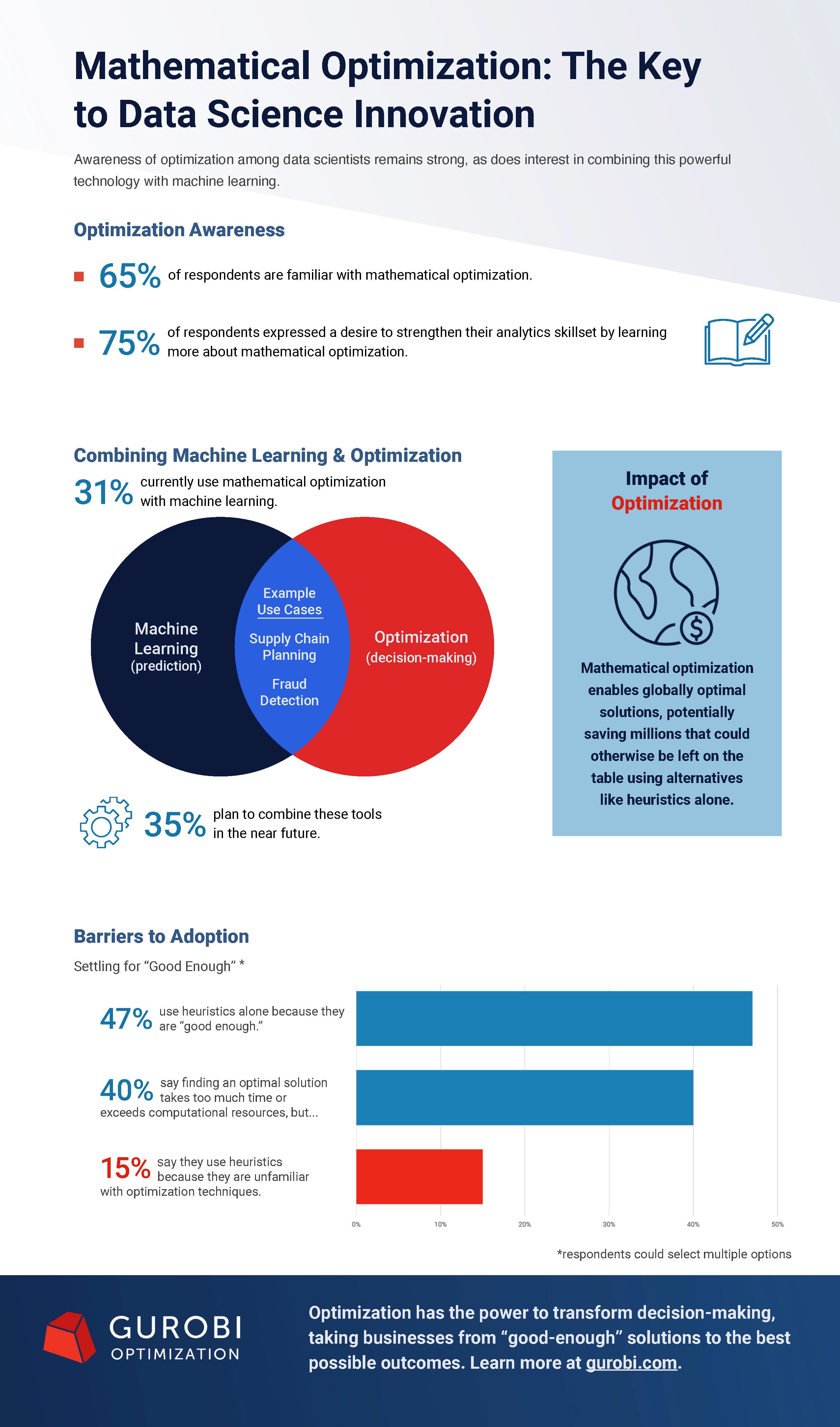
The infographic below explores some of the trends we’ve seen in how data scientists are using and learning about optimization, with insights from our annual State of Mathematical Optimization in Data Science report.
Optimization and Machine Learning: A Power Duo
Optimization and machine learning address two different questions, but that doesn’t mean they aren’t complementary.
In fact, according to our annual report, 66% of respondents currently use mathematical optimization in combination with machine learning, or plan to do so in the near future.
Here are a few examples of how these two technologies can be used together to make an even bigger impact:
Supply chain planners can use machine learning to forecast demand, then feed those forecasts into a mathematical model to optimize logistics, inventory, and routing.
Financial managers can predict market trends with machine learning, then optimize portfolios or trading strategies using those insights.
Energy companies can predict solar/wind energy availability using machine learning, then optimize energy grid operations based on those predictions.
The Importance of Continuous Learning
Despite optimization’s growing prominence in the data science field, there’s still plenty to be learned, especially as the technology continues to evolve and more resources become available to help data scientists master optimization.
According to our survey, 47% of data scientists still rely on heuristics alone because they are “good enough,” with 15% stating that they use heuristics because they are unfamiliar with optimization techniques.
While heuristics alone may sometimes be “good enough,” the difference between a locally optimal heuristic-based solution and a globally optimal one could be millions in savings or efficiency gains.
Gurobi has a plethora of resources dedicated to helping data scientists leverage optimization. To get started, visit gurobi.com/learn.
To learn more about the State of Mathematical Optimization in Data Science, download the complete report.
