Skip to Main Content
Webinar
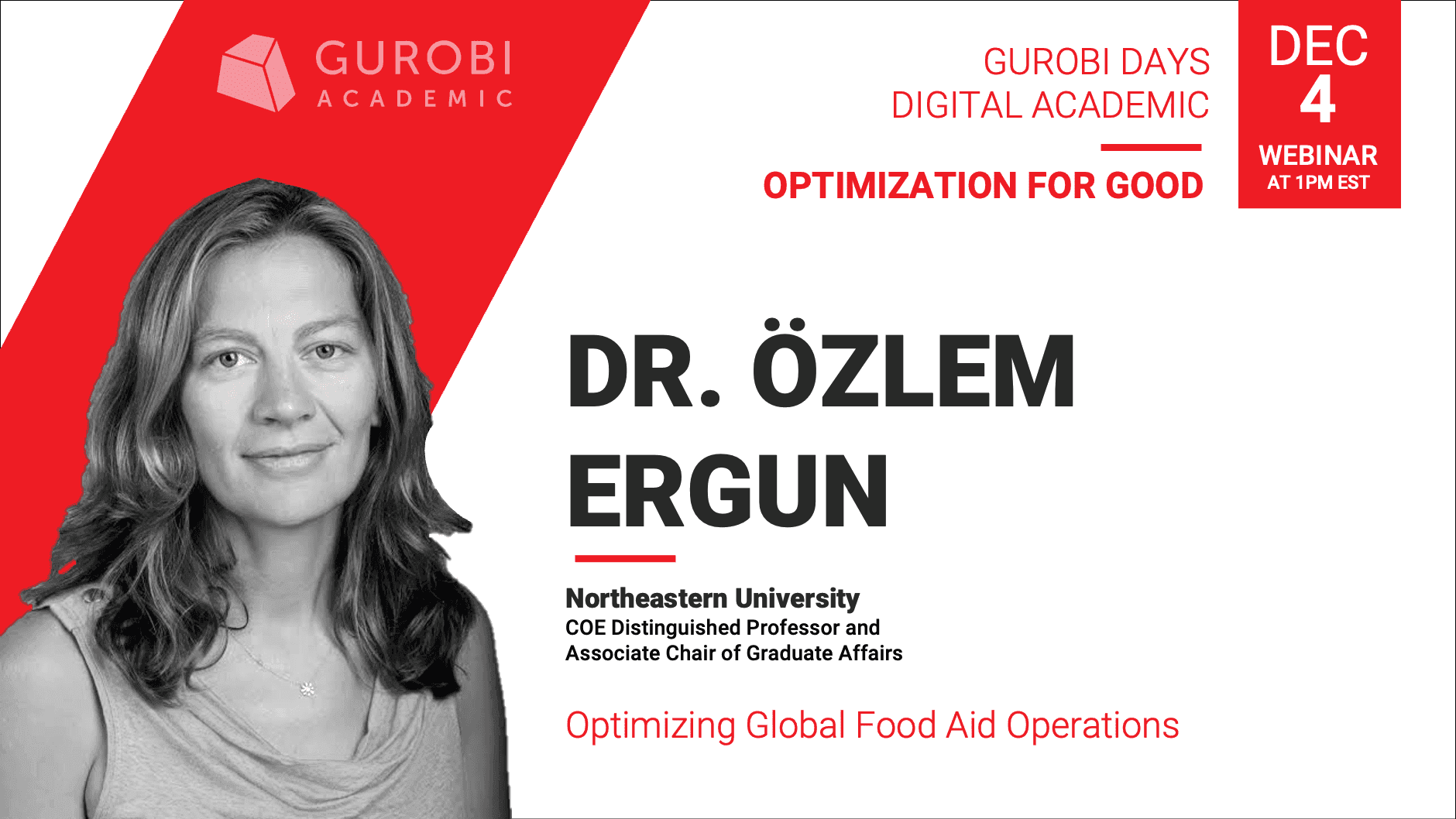
Optimizing Global Food Aid Operations
Gurobi describes its efforts in optimizing global food aid operations using mathematical programing in collaboration with UN World Food Program and USAID.
December 4, 2024
Webinar
Optimizing Global Food Aid Operations
Gurobi describes its efforts in optimizing global food aid operations using mathematical programing in collaboration with UN World Food Program and USAID.
December 4, 2024
Webinar
Optimizing Global Food Aid Operations
Gurobi describes its efforts in optimizing global food aid operations using mathematical programing in collaboration with UN World Food Program and USAID.
December 4, 2024
December 4, 2024 at 1 PM EST
We describe our efforts in optimizing global food aid operations using mathematical programing in collaboration with UN World Food Program and USAID for over 15 years.
The World Food Programme (WFP) is the largest humanitarian agency fighting hunger worldwide, reaching approximately 90 million people with food assistance across 80 countries each year. We describe a mixed integer linear programming model that simultaneously optimizes the food basket to be delivered, the sourcing plan, the delivery plan, and the transfer modality of a long-term recovery operation for each month in a predefined time horizon. By connecting traditional supply chain elements to nutritional objectives, we are able to make significant breakthroughs in the operational excellence of WFP’s most complex operations. We show three examples of how the optimization model is used to support operations: (1) to reduce the operational costs in Iraq by 12\% without compromising the nutritional value supplied, (2) to manage the scaling-up of the Yemen operation from three to six million beneficiaries, and (3) to identify sourcing strategies during the El Niño drought of 2016.
Each year, the Bureau for Humanitarian Assistance (BHA) under the U.S. Agency for International Development (USAID) plays a vital role in the global distribution of food aid. However, meeting the increasing demand with finite resources remains a persistent challenge. We examine the USAID global food aid supply chain, focusing on its multi-echelon, multi-commodity, and multi-modal nature. We adopt a multi-stage stochastic programming model to optimize warehouse locations and safety stock levels. This model integrates pre-disaster pre-positioning with post-disaster inventory replenishment, effectively catering to both deterministic (ongoing) and stochastic (sudden-onset) demands. Leveraging Variational Recurrent Autoencoders (VRAE) and Long Short-Term Memory (LSTM) networks, our approach enhances demand pattern analysis and realistic scenario planning. We aim to optimize BHA/FFP’s food aid procurement, prepositioning, and distribution strategies, thereby enhancing the resiliency and responsiveness of USAID’s global food aid operations.
December 4, 2024 at 1 PM EST
We describe our efforts in optimizing global food aid operations using mathematical programing in collaboration with UN World Food Program and USAID for over 15 years.
The World Food Programme (WFP) is the largest humanitarian agency fighting hunger worldwide, reaching approximately 90 million people with food assistance across 80 countries each year. We describe a mixed integer linear programming model that simultaneously optimizes the food basket to be delivered, the sourcing plan, the delivery plan, and the transfer modality of a long-term recovery operation for each month in a predefined time horizon. By connecting traditional supply chain elements to nutritional objectives, we are able to make significant breakthroughs in the operational excellence of WFP’s most complex operations. We show three examples of how the optimization model is used to support operations: (1) to reduce the operational costs in Iraq by 12\% without compromising the nutritional value supplied, (2) to manage the scaling-up of the Yemen operation from three to six million beneficiaries, and (3) to identify sourcing strategies during the El Niño drought of 2016.
Each year, the Bureau for Humanitarian Assistance (BHA) under the U.S. Agency for International Development (USAID) plays a vital role in the global distribution of food aid. However, meeting the increasing demand with finite resources remains a persistent challenge. We examine the USAID global food aid supply chain, focusing on its multi-echelon, multi-commodity, and multi-modal nature. We adopt a multi-stage stochastic programming model to optimize warehouse locations and safety stock levels. This model integrates pre-disaster pre-positioning with post-disaster inventory replenishment, effectively catering to both deterministic (ongoing) and stochastic (sudden-onset) demands. Leveraging Variational Recurrent Autoencoders (VRAE) and Long Short-Term Memory (LSTM) networks, our approach enhances demand pattern analysis and realistic scenario planning. We aim to optimize BHA/FFP’s food aid procurement, prepositioning, and distribution strategies, thereby enhancing the resiliency and responsiveness of USAID’s global food aid operations.
December 4, 2024 at 1 PM EST
We describe our efforts in optimizing global food aid operations using mathematical programing in collaboration with UN World Food Program and USAID for over 15 years.
The World Food Programme (WFP) is the largest humanitarian agency fighting hunger worldwide, reaching approximately 90 million people with food assistance across 80 countries each year. We describe a mixed integer linear programming model that simultaneously optimizes the food basket to be delivered, the sourcing plan, the delivery plan, and the transfer modality of a long-term recovery operation for each month in a predefined time horizon. By connecting traditional supply chain elements to nutritional objectives, we are able to make significant breakthroughs in the operational excellence of WFP’s most complex operations. We show three examples of how the optimization model is used to support operations: (1) to reduce the operational costs in Iraq by 12\% without compromising the nutritional value supplied, (2) to manage the scaling-up of the Yemen operation from three to six million beneficiaries, and (3) to identify sourcing strategies during the El Niño drought of 2016.
Each year, the Bureau for Humanitarian Assistance (BHA) under the U.S. Agency for International Development (USAID) plays a vital role in the global distribution of food aid. However, meeting the increasing demand with finite resources remains a persistent challenge. We examine the USAID global food aid supply chain, focusing on its multi-echelon, multi-commodity, and multi-modal nature. We adopt a multi-stage stochastic programming model to optimize warehouse locations and safety stock levels. This model integrates pre-disaster pre-positioning with post-disaster inventory replenishment, effectively catering to both deterministic (ongoing) and stochastic (sudden-onset) demands. Leveraging Variational Recurrent Autoencoders (VRAE) and Long Short-Term Memory (LSTM) networks, our approach enhances demand pattern analysis and realistic scenario planning. We aim to optimize BHA/FFP’s food aid procurement, prepositioning, and distribution strategies, thereby enhancing the resiliency and responsiveness of USAID’s global food aid operations.

Speakers
Meet Your Expert Speakers
Learn from the best in the industry.
Özlem Ergun
Professor Northeastern University & Co-Founder Center for Health & Humanitarian Systems, Georgia Institute of Technology
Enter a valid public image URLDr. Özlem Ergun is a College of Engineering Distinguished Professor and Associate Chair for Graduate Studies in Mechanical and Industrial Engineering at Northeastern University. Dr. Ergun’s research focuses on design and management of large-scale and decentralized networks. She has applied her work on network design, management, and resilience to problems arising in many critical systems including transportation, pharmaceuticals, and healthcare. She has worked with organizations that respond to emergencies and humanitarian crises around the world, including USAID, UN WFP, UNHCR, IFRC, OXFAM America, CARE USA, FEMA, USACE, CDC, AFCEMA, and MedShare International. Recently, Dr. Ergun partnered with the Massachusetts’ Executive Office of Elder Affairs (EOEA) to help match qualified medical professionals to Long Term Care facilities with open positions around the state as part of the state’s response efforts to COVID19. Dr. Ergun also served as a member of the National Academies Committee on Building Adaptable and Resilient Supply Chains after Hurricanes Harvey, Irma, and Maria and the National Academies Committee on Security of America’s Medical Supply Chain. She was the President of INFORMS Section on Public Programs, Service and Needs in 2013 and is an INFORMS fellow. She served as the Area Editor at the Operations Research journal for Policy Modeling Public Sector Area and currently serves as the Department co-Editor at MSOM journal for Environment, Health and Society Department.
Prior to joining Northeastern Dr. Ergun was the Coca-Cola Associate Professor in the School of Industrial and Systems Engineering at Georgia Institute of Technology, where she also co-founded and co-directed the Health and Humanitarian Systems Research Center at the Supply Chain and Logistics Institute. She received a B.S. in Operations Research and Industrial Engineering from Cornell University in 1996 and a Ph.D. in Operations Research from the Massachusetts Institute of Technology in 2001.
Speakers
Meet Your Expert Speakers
Learn from the best in the industry.
Özlem Ergun
Professor Northeastern University & Co-Founder Center for Health & Humanitarian Systems, Georgia Institute of Technology
Enter a valid public image URLDr. Özlem Ergun is a College of Engineering Distinguished Professor and Associate Chair for Graduate Studies in Mechanical and Industrial Engineering at Northeastern University. Dr. Ergun’s research focuses on design and management of large-scale and decentralized networks. She has applied her work on network design, management, and resilience to problems arising in many critical systems including transportation, pharmaceuticals, and healthcare. She has worked with organizations that respond to emergencies and humanitarian crises around the world, including USAID, UN WFP, UNHCR, IFRC, OXFAM America, CARE USA, FEMA, USACE, CDC, AFCEMA, and MedShare International. Recently, Dr. Ergun partnered with the Massachusetts’ Executive Office of Elder Affairs (EOEA) to help match qualified medical professionals to Long Term Care facilities with open positions around the state as part of the state’s response efforts to COVID19. Dr. Ergun also served as a member of the National Academies Committee on Building Adaptable and Resilient Supply Chains after Hurricanes Harvey, Irma, and Maria and the National Academies Committee on Security of America’s Medical Supply Chain. She was the President of INFORMS Section on Public Programs, Service and Needs in 2013 and is an INFORMS fellow. She served as the Area Editor at the Operations Research journal for Policy Modeling Public Sector Area and currently serves as the Department co-Editor at MSOM journal for Environment, Health and Society Department.
Prior to joining Northeastern Dr. Ergun was the Coca-Cola Associate Professor in the School of Industrial and Systems Engineering at Georgia Institute of Technology, where she also co-founded and co-directed the Health and Humanitarian Systems Research Center at the Supply Chain and Logistics Institute. She received a B.S. in Operations Research and Industrial Engineering from Cornell University in 1996 and a Ph.D. in Operations Research from the Massachusetts Institute of Technology in 2001.
Speakers
Meet Your Expert Speakers
Learn from the best in the industry.
- Enter a valid public image URL
Professor Northeastern University & Co-Founder Center for Health & Humanitarian Systems, Georgia Institute of Technology
Özlem Ergun
